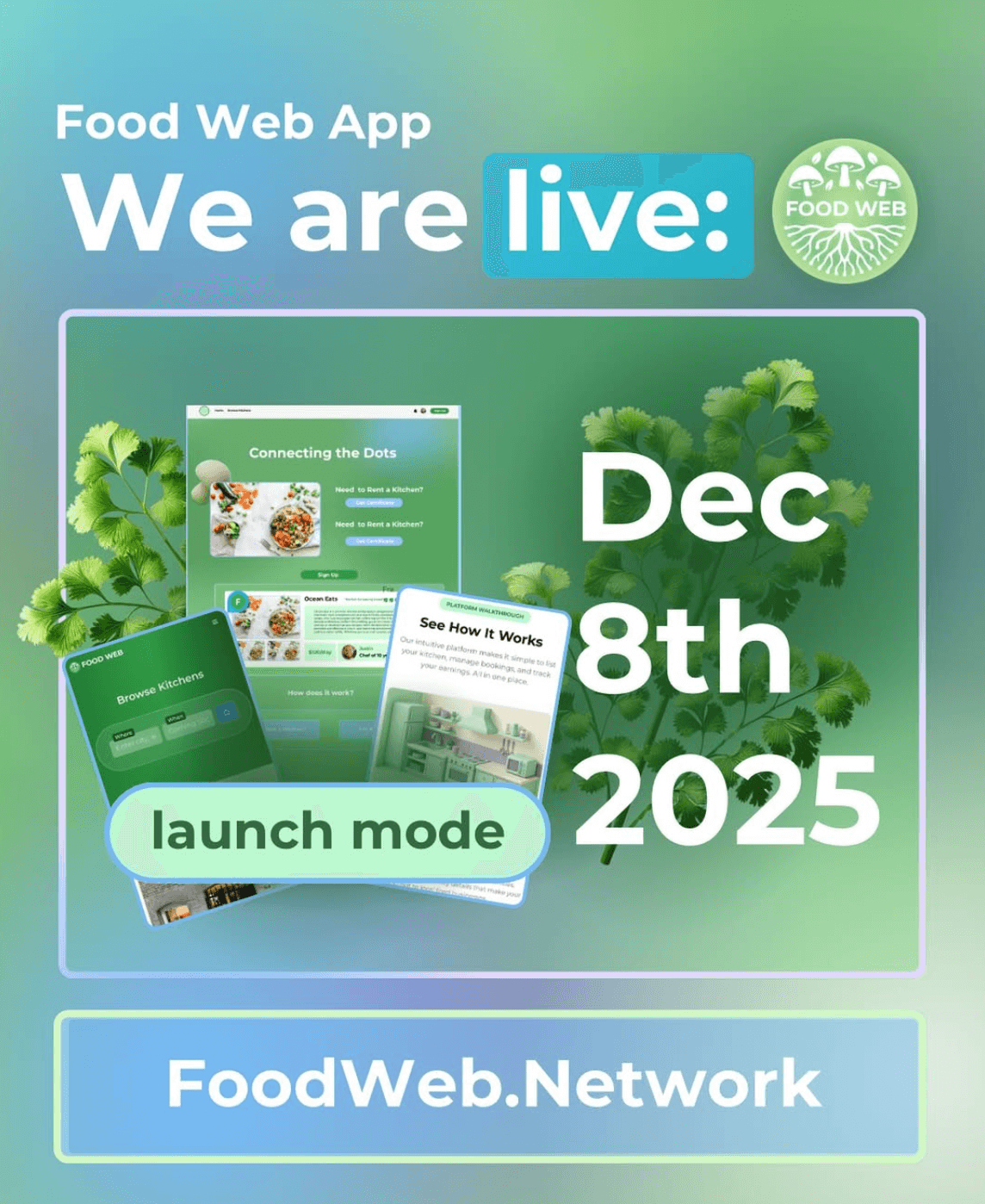
Food Web announced grand launch of new platform for sharing kitchens. It makes it easy to find and book licensed commercial kitchens in Nova Scotia, New Brunswick, and PEI.
News
Written by
Justin Andrews
Justin Andrews is a chef-turned-founder who has spent the last decade working across farms, markets, restaurants, nonprofits, and academic research. He’s now the CEO of Food Web, a platform built to unlock underused commercial kitchens and strengthen local food systems. Justin writes about food, entrepreneurship, and the work of building resilient local economies.
Join our network of kitchen providers and start earning from your unused commercial kitchen space.
HALIFAX, NS - November 17th, 2025
Food Web, a Nova Scotia based startup dedicated to strengthening local food systems, is proud to announce the official Grand Launch of Food Web Kitchens on December 8th!
Food Web is a digital platform that connects commercial kitchens with food entrepreneurs who need licensed space to operate. After two years of research, partnerships, and on-the-ground community engagement across Atlantic Canada, Food Web Kitchens is now live and ready for kitchen owners to begin listing their spaces. As part of the launch celebration, kitchens that sign up before December 8 will receive 25% off platform fees for a full year.
Building the Infrastructure for Local Food Businesses
Across Atlantic Canada, thousands of commercial kitchens sit unused for large portions of the week. From churches and community centres to restaurants, cafés, farmers’ markets, and event facilities. At the same time, demand for part-time kitchen access continues to rise among:
Farmers’ market vendors
Caterers and meal prep companies
Bakers and confectioners
Packaged food brands
Immigrant-led food businesses
Early-stage food entrepreneurs
Many of these businesses need only part time kitchen access (as little as one day per week) so they can get off the ground.
Introducing Food Web Kitchens
A Clear, Simple Platform for Shared Kitchen Use
Food Web Kitchens makes it easy for commercial kitchens to offer their space for part-time use, and just as easy for food entrepreneurs to find a licensed place to work. The platform brings everything into one streamlined system so both sides can operate with confidence and clarity.
How It Works for Kitchen Owners & Operators
Food Web makes it simple for kitchen owners and operators to monetize their kitchen by renting out unused hours in a safe, structured, and fully managed way. Kitchen owners can:
List their kitchen in minutes with a guided onboarding flow
Set their own availability and hourly rates
Connect only with vetted, document-ready food businesses
Let the platform handle admin: bookings, payments, agreements, and messaging
Earn extra revenue from hours that would otherwise sit empty
How It Works for Food Entrepreneurs & Renters
Food entrepreneurs use Food Web to:
Browse licensed kitchens across Nova Scotia (and beyond)
Join a regional waitlist if no kitchens are available nearby
See what’s required to operate legally before they book
Upload insurance and documents in one central profile
Communicate and book directly through the platform
Pay securely without chasing invoices or unclear expectations
This gives renters a clear pathway to access safe, affordable, licensed space.
Early-Bird Promotion for Kitchen Owners
To celebrate the Grand Launch, kitchens that sign up before December 8 receive:
This offer is designed to reward early adopters and help seed the first wave of shared-use kitchens across Nova Scotia.
Want to Learn More?
We’re here to help. If you want to understand shared kitchens, see the platform in action, or talk through your specific needs, our webinars and demo calls are the best place to start.
For kitchens or food entrepreneurs wanting individualized support, Food Web offers personal demo calls where you can preview the platform, ask detailed questions, discuss your specific situation, and get clarity on what you need to get started.
One of the clearest insights to emerge from our work over the past two years is just how widespread the challenge of kitchen access really is. No matter where we went, Cape Breton, the Valley, the South Shore or Halifax, it didn’t matter who we spoke to.
Everyone was saying the same thing.
Farmers’ market managers told us about talented vendors who couldn’t scale because they couldn’t secure consistent kitchen time. Economic development officers spoke about entrepreneurs in their regions who were ready to grow but stalled out waiting for a licensed space. Food business owners shared stories of sending dozens of emails, making countless phone calls, and still ending up without a kitchen.
Across rural communities, small towns, and even in Halifax, the barrier was identical: finding a kitchen to rent was confusing, inconsistent, and often impossible.
Focus group held in Sydney
To better understand these challenges, and to build solutions rooted in real, lived experience, Food Web facilitated a province-wide series of focus groups funded by a LearnSphere commercialization grant. Over the course of the tour, we met with:
Farmers and market vendors
Immigrant entrepreneurs
Caterers and bakers
Community kitchen managers
Public health workers
Nonprofits and community food organizations
Municipal and regional economic development officers
We heard the same frustration again and again, expressed in different accents, different buildings, and different contexts, but always the same message “We need better access to commercial kitchens.”
Focus group hosted in Yarmouth
Years in the Making: Research That Shaped the Platform
Before Food Web launched its province-wide engagement this spring, the foundation for Food Web Kitchens had already been developing for years. What looks like a new platform today is actually the culmination of long-term research, lived experience, academic collaboration, and countless conversations with people working across Nova Scotia’s food system.
Food Web’s approach is grounded in multiple layers of research, each helping us understand the barriers facing food entrepreneurs and the untapped potential inside community kitchens.
Validation Through Lab2Market Incubator
During Dal Innovates Lab2Market Launch program, we conducted interviews with more than 80 food businesses across Atlantic Canada. Their stories were remarkably consistent: Difficulty finding kitchens, unclear approval processes, inconsistent pricing, and lost opportunities due to lack of access. These conversations confirmed that the kitchen-access problem wasn’t isolated; it was widespread and structural.
Long-Term Academic Partnerships
For two consecutive years, Food Web partnered with Dalhousie University’s College of Sustainability, where student researchers examined shared-use kitchen models, mapped local food infrastructure, studied regulatory barriers, and interviewed food entrepreneurs. Their findings laid the early conceptual groundwork for what Food Web Kitchens would eventually become. Read the Research
Insights from Lived Experience
Food Web’s roots also come from lived experience. As a former chef, farmers’ market vendor, and local food educator, founder Justin Andrews struggled for years to find consistent kitchen access. The obstacles he experienced personally, along with the challenges faced by the entrepreneurs he supported, reinforced the need for a simple, modern solution.
Together, these years of research shaped the core of Food Web Kitchens. They informed how the platform is designed, how documentation is handled, how bookings work, and why everything is built to be clear, accessible, and supportive for both kitchen owners and renters.
The People Behind Food Web
Food Web is built by people who have lived and worked inside the food system for years — people who understand the challenges firsthand and are committed to strengthening the region’s local food economy. Our team brings together culinary experience, community engagement, technology expertise, and decades of combined leadership across food, sustainability, and entrepreneurship.
Core Team
Justin Andrews — Co-Founder & CEO
A professionally trained chef turned food systems researcher and entrepreneur, Justin has spent his career working across farms, markets, kitchens, nonprofit programs, and academic research. His lived experience struggling to access commercial kitchens forms the foundation of Food Web’s mission. Justin leads strategy, partnerships, and community engagement across Atlantic Canada.
Keegan Francis — Co-Founder & CTO
A technology entrepreneur with deep experience in digital infrastructure, platforms, and Web3 systems, Keegan leads all product and engineering work at Food Web. He brings years of startup experience, technical leadership, and a passion for building tools that empower communities.
Mariah Pelley-Smith — Designer & Brand Architect
Mariah Pelley-Smith is a brand strategist and UX/UI consultant who bridges the worlds of branding, design, and technology to build impactful, user-centered businesses. As the founder of MIBV, Embodied Wealth Academy, and Creative DAM, she has spent nearly a decade crafting compelling brand identities, refining digital experiences, and integrating emerging technologies to drive business transformation.
Advisors
Food Web is guided by a group of advisors who bring deep, diverse expertise from across food systems, entrepreneurship, technology, and local economic development.
Lil MacPherson: Co-founder of The Wooden Monkey restaurant and a long-time champion of the local food movement in Nova Scotia. Lil brings decades of experience building sustainable food businesses and navigating public policy, community engagement, and local food advocacy.
Andrew Bergel: Director of the College of Sustainability at Dalhousie University, professor, and former hedge fund manager. Andrew provides guidance on finance, sustainability, academic partnerships, and strategic thinking.
Rebecca Tran: Owner of The Station Food Hub, a regional food processing facility. Rebecca understands the operational realities of shared-use kitchens, food production, and local food logistics. Her insight strengthens Food Web’s approach to infrastructure sharing.
James Wood: Software developer and food entrepreneur based in Montreal. James has personally experienced the challenge of finding kitchen space for his own food business, and he brings technical expertise, lived experience, and support for expansion into Quebec and French-speaking markets.
Contact Us
We welcome conversations with anyone interested in shared kitchens, local food systems, or Food Web’s work across Nova Scotia. Whether you’re a journalist, a community partner, a kitchen owner, or a food entrepreneur, we’d be happy to connect.
For media inquiries, interview requests, or quotes, please reach out directly.
For general questions, partnership ideas, or support getting started, we’re also here to help.




 Anna Purna
 Justin Andrews
