Food asset maps help people find and understand local food resources. This post explores how they’re used across Canada and how Food Web is building a more connected, collaborative approach.
ResearchFood Asset MappingFood Maps
Written by
Justin Andrews
Justin Andrews is a chef-turned-founder who has spent the last decade working across farms, markets, restaurants, nonprofits, and academic research. He’s now the CEO of Food Web, a platform built to unlock underused commercial kitchens and strengthen local food systems. Justin writes about food, entrepreneurship, and the work of building resilient local economies.
Find kitchens near you
Explore commercial kitchens, farms, markets, and food assets on the Food Web map.
Did you know there are over 70 food maps across Canada?
They take many forms. Some show where farmers’ markets are held each week. Others help people locate food banks, community gardens, shared kitchens, or food programs in their area. Some are simple directories.
Together, these maps reflect a growing interest in understanding and supporting local food systems. At the same time, many households are under financial pressure, and people need clear, reliable ways to find food access supports when they need them.
As more people try to shop local, shorten supply chains, and stay connected to their communities, knowing where food is and where support exists, has become more important than ever.
Food maps are used in different ways:
Community members use them to find food or services
Small Businesses use them tofind a part time kitchen to rent
Non-profits use them to understand who else is working in the space
Researchers use them to identify gaps or inequities in food access
Governments use them to support planning, policy, and funding decisions
Map prepared by Farmers Markets of Nova Scotia of the markets part of their co-op.
Maps like this farmers’ market map help people quickly see where and when local markets are happening. These kinds of maps make it easier to buy local, support farmers, and stay connected to seasonal food close to home.
Other Maps like the one below created by the Mobile Food Market in Halifax shows several different things including: food banks, community gardens and advocacy support programs. This is called Food Asset Map: a way of seeing all the places, programs, and infrastructure that help food move through a community. From food banks and grocery stores, to shared kitchens a small business rents once a week, these are all ‘food assets’.
Mapping these assets together is what inspired us to create Food Web, short for our full name: Food Web Asset Mapping INC.
A map prepared by the JustFOOD Action Plan and the Mobile Food Market in Halifax
How Food Asset Mapping Is Used
As outlined above, food asset mapping brings together many different food-related resources in a community and visualizes them in one place. These assets can include farmers’ markets, food banks and community gardens, but food asset maps can also incorporate broader data that’s relevant for research, planning, and government programming.
Some maps go beyond listing food locations and begin to show how food access is shaped by broader conditions. For example, the map below published by the Government of Quebec, uses geospatial data to highlight urban food deserts. In this map, darker areas indicate communities where food insecurity is more likely.
Map of Montreal showing how some neighbourhoods have higher rates of food insecurity then others, based on available food resources. Prepared by Government of Quebec
In many cases, this isn’t simply about how far a grocery store is. It’s about accessibility. In some neighbourhoods, residents may lack public transportation routes to reach stores, especially if they don’t own a car. By contrast, areas in the urban core of cities like Montréal often have more grocery stores in walking distance and stronger transit connections.
Maps like this make it possible to see how food access can vary dramatically, even within a single city. It can identify specific neighbourhoods that may be struggling more than others.
Reviewing Food Asset Maps Across Canada
There are now many food asset maps across Canada, each showing different types of information for different regions and purposes.
A 2024 national review published in the Canadian Food Studies Journal (Li et al., 2024) identified 73 food asset maps across Canada. This shows widespread interest in making food systems more visible and easier to understand. Many of these maps were created to support food security initiatives, local food systems, and community planning.
At the same time, the review highlights how varied these maps are. Some are designed primarily for consumers (helping people find farmers’ markets or food programs), while others are built for research, policy analysis, or program design.
Food Web’s Research on Food Asset Mapping
Food Web has studied this landscape closely. Through a partnership with Dalhousie University’s College of Sustainability, we worked with a team of five capstone students who supported Food Web as part of their final-year internship project.
The students helped us review and analyze over 40 Canadian food asset maps, looking at how they function, what types of data they include, how they are maintained, and whether they are kept up to date.
Most food asset maps are created with care and good intentions. The challenges they face are rarely about design quality or commitment, they are structural. Some of the most common constraints include:
Information Becomes Outdated
Keeping food system data current requires ongoing time and capacity. Many food asset maps come together as one off grant funded projects, but don’t have dedicated staff or resources to maintain listings once the initial work is complete.
In our review of food asset maps across Canada, we regularly encountered broken links, outdated contact information, or programs that no longer existed. Without a clear plan or resources for long-term maintenance, even well-designed maps can quickly lose accuracy.
Short-Term Funding for Long-Term Needs
This challenge is closely tied to how food asset mapping is funded. Grant programs often prioritize new projects and innovation. Securing funding to continue, maintain, or steward an existing tool over time can be much more difficult.
As a result, significant effort is repeatedly invested in creating new maps, while the infrastructure needed to keep them accurate and useful is often missing. Over time, this leads to a familiar pattern: strong launches followed by gradual decay. None of this means food asset mapping is failing. On the contrary, it highlights how important these tools are, and how we support and structure them needs to evolve if they are to remain useful.
Limited Ways to Contribute
In many cases, organizations listed on a food asset map cannot update their own information directly. To make changes, they must contact the map’s administrators, creating delays and placing the burden of accuracy on a single organization or small team.
This also limits broader community contribution. For example, a resident might notice that a farmers’ market in their neighbourhood isn’t listed, or that a program has changed locations, but have no easy way to suggest an update. Over time, this creates bottlenecks and makes it difficult for maps to reflect what’s actually happening on the ground.
Static Listings That Send You Elsewhere
Many food asset maps function primarily as directories. They list an organization and then link users off-platform to learn more. This makes it harder to understand relationships between organizations or to see how different parts of the food system connect. When information lives elsewhere, maps become starting points rather than places where understanding is built. This limits their ability to show the food system as a system.
Fragmentation Across Platforms
Finally, fragmentation remains a major challenge. With more than 70 food asset maps built by different organizations across Canada, often using different digital tools and data structures, information is scattered across silos.
These maps don’t talk to each other, data isn’t easily shared, and similar work is repeated in different regions. While each map may serve its local purpose, the overall ecosystem becomes harder to navigate, maintain, and scale.
Food Web’s Approach
Food Web was created in response to these challenges.
Rather than building another standalone map, we’re developing a national food system mapping platform. It is designed to be used by anyone, anywhere, and to grow over time. The goal is shared infrastructure: something communities, researchers, governments, and food businesses can all use without having to reinvent the same tools at different local scales.
Our approach is guided by a few core principles.
National (and Eventually Global)
Food systems don’t stop at municipal or provincial boundaries. A national platform makes it easier for community members, researchers, governments, food businesses, and organizations to work from a shared foundation, rather than building separate tools in isolation. This creates more opportunities for collaboration, comparison, and learning across regions, while still supporting local context.
Free at Its Core
Food Web is a business, but access to food system information should be a public good. The core mapping functions (finding food-related resources, exploring what exists in a community, and collaborating with others) are free and will remain so.
Over time, there will be optional paid tools and advanced features designed for specific use cases, such as business operations or specialized data visualization. But the foundation of Food Web is built to ensure that discovering resources, understanding food systems, and connecting at a community level is accessible to everyone.
Living Data, Collaborative by Design
Food systems change constantly, and maps need to reflect that. Food Web is designed as a living data platform, where people and organizations can add to the map, suggest updates, and help keep information current.
This shifts the burden of maintenance away from a single organization and toward shared stewardship. We’re building systems that allow community validation and moderation, so information can improve over time while maintaining quality and trust. As more people contribute, the map becomes more complete, more accurate, and more useful.
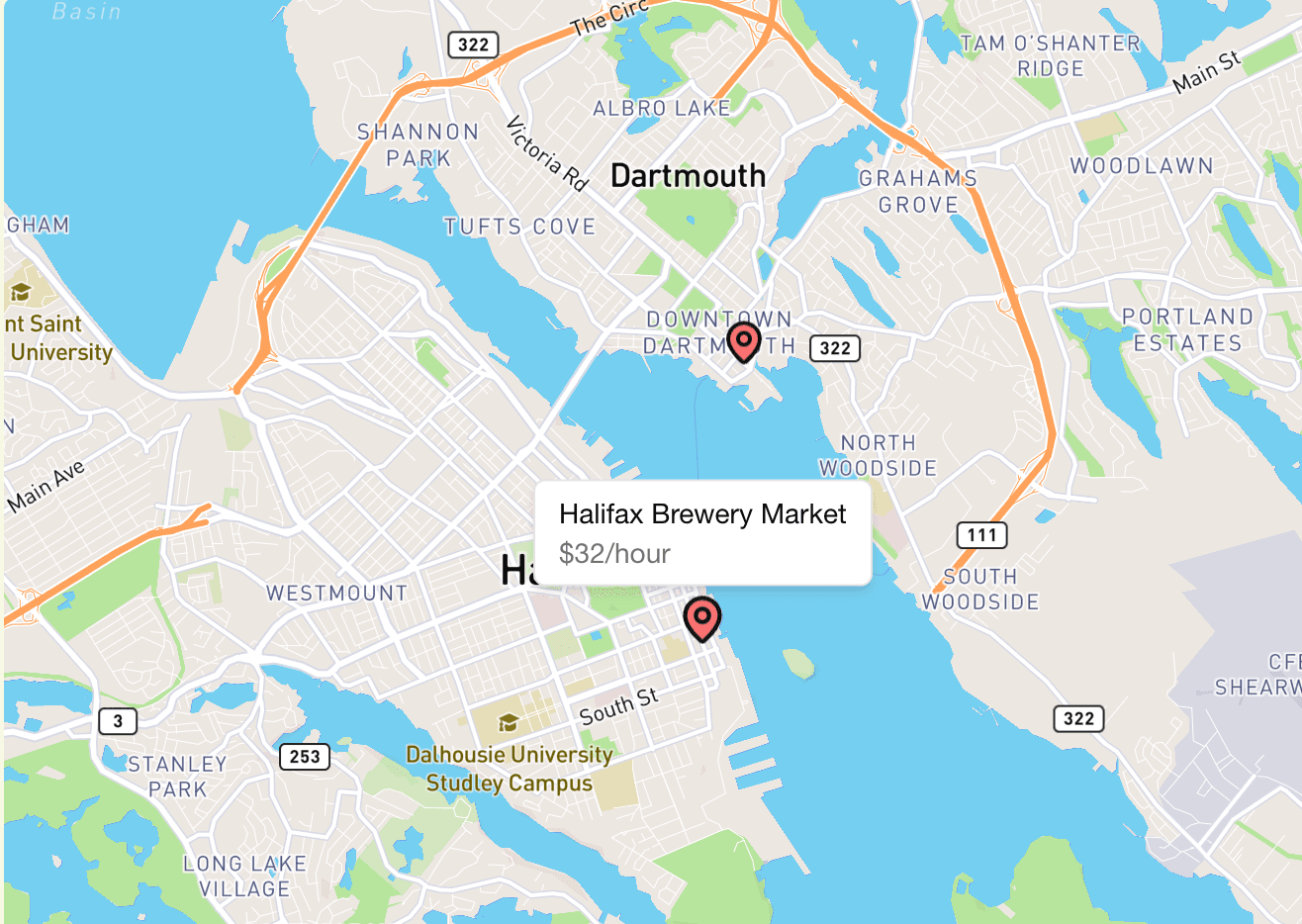
Screenshot of Food Web Kitchens Platform showing kitchens available for rent
More Than Just Directory Listings
Food Web goes beyond static directories. In addition to mapping food assets, we’re building tools that help people connect and take action, including event listings, discussion forums.
We’re also already building functional tools that move beyond “seeing” resources to actually using them. One example is Food Web Kitchens, our first app that is now live! It allows food businesses to browse available kitchens and book them directly, turning a listing into real, usable infrastructure.
Built to Be Built On
Food Web is designed as shared infrastructure. If you’re building an app or running a project that supports food it shouldn’t have to live on its own island. Food Web is built so those kinds of tools can connect into a shared ecosystem, rather than everyone starting from scratch with their own lists, maps, and databases.
By sharing common information about food resources, Food Web helps different tools and projects “talk to each other.” That makes it easier for people to discover what already exists, see how things are connected, and move between platforms without losing context.
The goal isn’t competition, it’s coordination. Food systems work best when tools are connected, information is shared, and people don’t have to navigate a maze of disconnected platforms to get things done.
Why This Matters Right Now
Food systems across Canada are under real pressure. The cost of food keeps going up, making it harder for many households to afford healthy options. At the same time, communities are facing increasing uncertainty driven by global supply chain disruptions, climate impacts, and geopolitical instability.
Canada is not immune to these forces. While we produce a great deal of food, we rely heavily on global inputs, seasonal labour, and long supply chains. When disruptions occur elsewhere in the world, their effects are often felt locally. On grocery store shelves, at food banks, and in community food programs.
In this context, knowing where food resources are, who is doing the work, and how communities are supporting one another becomes critically important. Food asset mapping helps make this information visible. It allows organizations to coordinate more effectively, helps researchers and planners spot gaps before they become crises, and gives communities clearer pathways to local food and food support.
As food systems become more complex and more fragile, shared, up-to-date information is no longer a nice-to-have. It’s mission critical!
Want to Follow Along?
If this resonates with you and you’re curious about this work, the best place to follow along is through The Food Web Podcast. We will be announcing details of the launch of our food map in February, and our podcast listeners will be given a special offer! 😄
We host a live podcast every week on Wednesday at 12:00pm AST (11 a.m. EST), where we talk openly about what we’re building and what’s coming next.
Li, B., Soma, T., Payment, R., Kumar, S., Anderson, N., Xu, F., & Piensatienkul, P. (2024). A review of food asset maps in Canada. Canadian Food Studies La Revue Canadienne Des études Sur l’alimentation, 11(2), 149–170. https://canadianfoodstudies.uwaterloo.ca/index.php/cfs/article/view/655