
The short answer
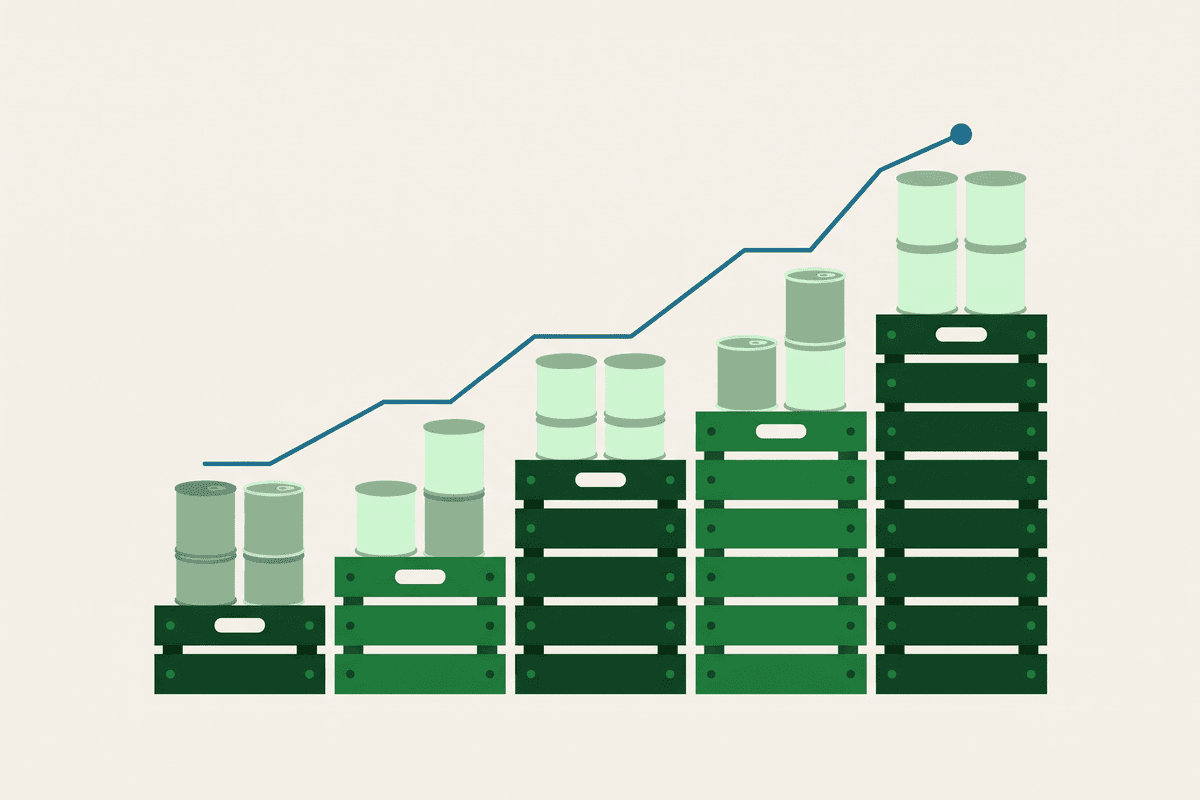
How many Canadians use food banks? Food Banks Canada's HungerCount 2026 recorded 2,355,075 food bank visits in a single month — the highest figure ever counted, 116.8% above 2019 and 8.7% above last year. Nearly a third of those visits were by children, and 18% of clients named employment as their main source of income.
- The headline number 2,355,075 visits in one month — 116.8% more than in 2019 and 8.7% more than in 2025.
- It is not unemployment 18% of clients name employment as their main source of income, up from 12% in 2019.
- A third are children 32.5% of visits — 775,658 of them — were by children.
- Almost everywhere at once Visits rose in every province and territory except Prince Edward Island and Newfoundland and Labrador.
- Counted nationally, found locally HungerCount is a national census. The help itself is a local food bank, community fridge or meal program.
2,355,075
food bank visits in a single month in 2026
Food Banks Canada, HungerCount 2026 — 116.8% above 2019 and 8.7% above 2025.
Source32.5%
of those visits were by children
Food Banks Canada, HungerCount 2026 — 775,658 visits by children.
Source18%
of clients name employment as their main income
Food Banks Canada, HungerCount 2026 — up from 12% in 2019.
SourceIf you want to know how many Canadians use food banks, there is one count that the sector, the press and the federal government all reach for, and it has just come back worse than it has ever been. Food Banks Canada published HungerCount 2026 under the title Impossible trade-offs, and the number at its centre is 2,355,075 visits in a single month. That is not a cumulative annual total. It is one month's worth of people walking through the door.
How many Canadians use food banks?
The honest answer is that nobody counts individual people — they count visits. HungerCount takes a point-in-time snapshot of a single month and asks food banks across the country how many times someone came for food in it. For 2026 that figure is 2,355,075. Someone who visits twice is counted twice; a family picking up one hamper may be counted as several visits. The number is a measure of demand on the system rather than a headcount of hungry Canadians, and reading it the other way overstates and understates the problem at the same time.
What makes the 2026 figure a genuine record is not only its size but its trajectory. It sits 116.8% above the same count in 2019 — more than double the pre-pandemic level — and 8.7% above 2025. A rise of that size in a single year, on top of a base that had already doubled, is the part worth sitting with.
What does HungerCount actually measure?
HungerCount has run since 1989, which is what gives the comparison its weight. Food Banks Canada describes it as a cross-sectional census survey of food bank agencies, organisations and programs — importantly, both inside and outside its own member network. That breadth matters: a count restricted to members would miss the church basements, campus pantries and independent community programs that absorb a large share of the need. If you are unclear on how that network is put together in the first place, our plain-English explainer on how food banks work covers the mechanics.
Two things follow from the method. First, "food bank statistics Canada" reporting that cites a different national number is usually citing a different thing — an annual total, a client count, or a provincial association's own survey. Second, because the same instrument has been used for decades, year-over-year movement is the most trustworthy signal in the report. The level is debatable. The direction is not.
Who is showing up at food banks?
The composition of the 2026 count is the part that should change how people think about food banks. Children accounted for 32.5% of visits — 775,658 of them. And 18% of clients reported employment as their main source of income, up from 12% in 2019. One in five people in the queue has a job.
That shift is the most important thing in the report. Food bank use in Canada has stopped being a reliable proxy for unemployment and has become a proxy for the gap between what work pays and what living costs. A food bank is no longer only a safety net for people out of the labour market; it is increasingly a top-up for people inside it.
Why do visits keep climbing?
Reporting on the release points at the obvious arithmetic. In coverage of the report, CP24 noted that food prices have risen nearly 30% since 2021, housing 28% and transportation nearly 24%. Incomes that did not move by comparable amounts leave a shortfall, and the shortfall shows up in the one part of a household budget that can be squeezed at short notice: groceries.
The increase is also close to universal. Visits rose in every province and territory except Prince Edward Island and Newfoundland and Labrador. Ontario recorded 846,724 visits and Quebec 785,889; British Columbia recorded 250,505, a 14% increase. The territories moved fastest in proportional terms — Yukon up 24%, the Northwest Territories and Nunavut up 29%.
Where do you find food support near you?
A national figure is useless at the moment you need groceries. Help is always a specific place with specific hours, which is why we keep city-level guides rather than one national directory — there are walkthroughs for Hamilton, Montreal, Halifax and Ottawa, each one built around the live directory that city's own network maintains rather than a list of addresses that goes stale.
The uncomfortable thing about a record like this one is how little a single number changes on the ground. What changes things is whether a person in a particular neighbourhood can find the door that is open this week. Mapping where food support actually exists is the slow, unglamorous half of the problem, and it is the half we work on. More reporting of this kind lives in Food News.
Frequently asked questions
- What is HungerCount?
- HungerCount is Food Banks Canada's annual national research study, running since 1989. It is a cross-sectional census survey of food bank agencies, organisations and programs both inside and outside the Food Banks Canada network, and it produces a point-in-time snapshot of food bank use across the country.
- Does 2.35 million mean 2.35 million different people?
- No. HungerCount counts visits, not individuals. Someone who goes to a food bank twice in the count month is counted twice, and a single hamper collected for a household can represent several visits. It measures demand on the system rather than the number of distinct people using it.
- Are employed people using food banks in Canada?
- Yes, and increasingly so. In HungerCount 2026, 18% of clients reported employment as their main source of income, compared with 12% in 2019. Food bank use now tracks the gap between wages and living costs more closely than it tracks unemployment.
- Did food bank visits rise everywhere in Canada?
- Almost. Visits rose in every province and territory except Prince Edward Island and Newfoundland and Labrador. Ontario recorded 846,724 visits and Quebec 785,889, while British Columbia recorded 250,505, a 14% increase. The largest proportional rises were in Yukon, the Northwest Territories and Nunavut.
- How do I find a food bank near me?
- Start with the live directory your province or city network maintains, since hours and locations change. Food Web's Asset Map also plots food banks, community fridges and meal programs by place, and we publish city-level guides for Halifax, Hamilton, Montreal, Ottawa and other Canadian cities.
Sources
- HungerCount 2026: Impossible trade-offs — Food Banks Canada
- More Canadians are visiting food banks than ever, with monthly visits hitting record high — CP24, Oct 21, 2026

Written by
Anna Purna
AI-assisted research and city guides, reviewed by the Food Web team
AI-assisted author, reviewed by the Food Web team.
Anna Purna is Food Web's AI writing assistant — an avatar named after Annapurna, the Hindu goddess of food, agriculture, and nourishment. The name is about abundance, not a person on staff. She drafts research-backed guides; a human editor reviews them before they go live.
Next step
See every food asset near you on one map
Commercial kitchens, farms, markets and processors, mapped and updated weekly.
No listing fees · 12% on completed bookings · Refunds inside the notice window