
Ask how do food banks work and most people picture a counter where somebody hands over a box. The reality is closer to a small logistics operation: food arrives from several different directions, gets sorted and stored, and then moves out again through a network of local organisations. Understanding that shape makes the whole system easier to use — whether you need help, want to give, or are explaining it to somebody else.
How do food banks get their food?
2,355,075
food bank visits across Canada in a single month
Food Banks Canada, HungerCount 2026 — visits recorded in March 2026, 117% higher than in 2019.
Source32.5%
of food bank clients are children
Food Banks Canada, HungerCount 2026 — 775,658 child visits in March 2026.
Source95.3M lbs
of surplus food rescued and redistributed in Canada in 2025
Second Harvest — rescued with its partners from more than 7,500 food donors.
SourceThree streams feed a food bank, and they behave very differently. Public donations — the food drive at the office, the bin at the supermarket door — are reliable but skew heavily toward tins and dry goods, because that is what survives a cardboard box in a lobby for three weeks. Purchased food lets an organisation fill specific gaps: infant formula, cooking oil, culturally appropriate staples it never receives by donation.
The third stream is the one that has changed most. Rescued surplus — food that is perfectly edible but has lost its commercial value — now arrives in volume from grocers, farms and processors. It is what puts dairy, bread, produce and protein on a shelf that donations alone would fill with pasta. It also explains why a modern food bank looks like a warehouse with refrigeration and a truck schedule rather than a church basement with shelving.

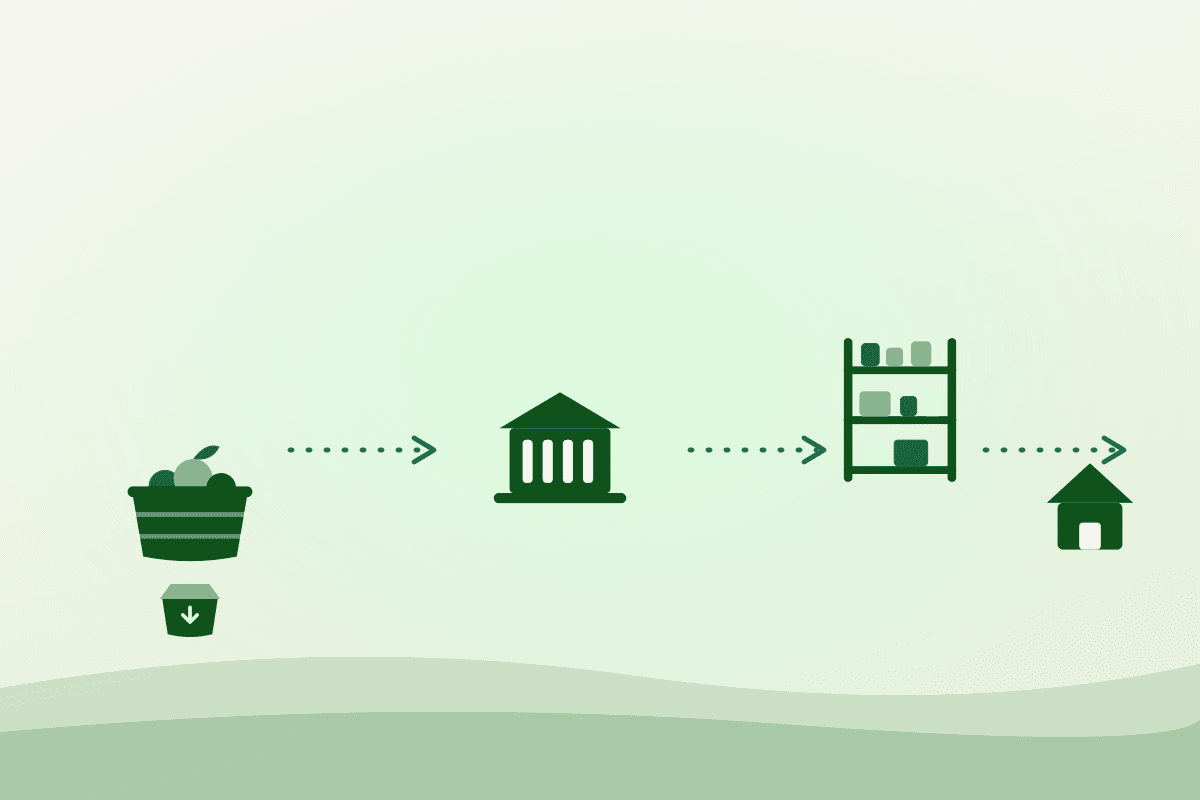
Once food is in, it is sorted, date-checked and either stored or moved on. The largest organisations rarely hand food to individuals at all. They operate as regional suppliers, trucking pallets to member agencies — neighbourhood food banks, shelters, school meal programs, multi-service centres — which are where people actually collect groceries. That two-layer structure is the single most common point of confusion, and it is why a city's best-known food bank name is often not an address you can visit.
Who can use a food bank, and how does registration work?
Anyone who cannot afford enough food can use a food bank. In practice registration means giving a name, the number of people in your household, and an address — the address because most organisations serve a defined catchment and need to confirm you are inside it. Some ask for photo ID or a piece of mail; many do not. Income testing is uncommon, and no reputable organisation asks you to justify why you need help.
How often you can go varies. A monthly hamper is the most common pattern, often by appointment; some organisations run weekly, and some operate choice-model markets where you walk the shelves and pick your own items the way you would in a shop. If you are unsure what a specific organisation expects, phoning ahead is faster than reading its website, because the rules are set locally rather than nationally. The HungerCount data makes one thing plain about who shows up: nearly a third of clients are children, 18% report employment as their main income, and single-person households are the most common household type. A job no longer reliably prevents needing one.
How is a food bank different from a food pantry, soup kitchen, or community fridge?
| Type | What you get | What it asks of you | When it helps most |
|---|---|---|---|
| Food bank | Groceries to take home and cook | Usually registration and an address in its catchment | A recurring shortfall between income and the grocery bill |
| Food pantry | Groceries, often from a smaller local stock | Light registration; often run by a church or community centre | A nearby top-up between larger pick-ups |
| Soup kitchen / community meal | A hot meal served ready to eat | Nothing — usually walk in during serving hours | No kitchen, no equipment, or needing to eat today |
| Community fridge | Whatever is in it right now | Nothing at all; no sign-in | Evenings and weekends, when everything else is closed |
| Community food centre | Groceries, meals, cooking programs and advocacy together | Membership or registration for some programs | Wanting support that is not only an emergency hamper |
The distinctions matter because they decide what you should ask for. Walking into a soup kitchen and asking for a week of groceries, or calling a food bank at 9pm, both end in a wasted trip. Many organisations now run several of these at once — a grocery market, a meal service and cooking workshops under one roof — so the useful question on the phone is simply which of them you are being offered. City guides such as our ones for Ottawa and Halifax show how the same categories play out in one place.
How can I help — donate, volunteer, or host a food drive?
Money goes further than tins, and this is not a polite fiction. A food bank buying in bulk, with rescue partnerships and a warehouse, converts a dollar into far more food than you can at retail prices — and it can buy the things it is actually short of rather than the things people tend to give. If you do donate food, check the organisation's published needs list first; most keep one, and most of them do not want more pasta.
Time is the other scarce input. Sorting, repacking and distribution days run on volunteers, and a standing weekly shift is worth more to an organisation than a one-off group visit at Christmas. Beyond individual giving, the infrastructure itself needs funding: programs like the Local Food Infrastructure Fund exist because a community organisation that cannot afford a walk-in cooler cannot accept rescued produce, no matter how much is on offer.
Common questions about how food banks work
- How do food banks get their money?
- Mostly from individual donations, corporate giving and fundraising events, with some grant funding from government programs for specific projects such as refrigeration or vehicles. Food banks in Canada are charities rather than government services, so core operating costs are generally not covered by public funding.
- Do you have to prove you are poor to use a food bank?
- Generally no. Most organisations ask for a name, household size and an address to confirm you live in the area they serve. Income verification is uncommon, and being asked to document hardship is not standard practice.
- What food do food banks actually need?
- It varies by organisation, which is why most publish a current needs list. Commonly short items include cooking oil, infant formula, culturally specific staples, personal hygiene products and protein. Cash is usually the most useful donation because bulk buying and rescue partnerships stretch it much further than retail prices.
- Can food banks give out fresh and frozen food?
- Many can, and increasingly do, because rescued surplus from grocers and farms brings in dairy, produce, bread and meat. Whether a particular location offers it depends on whether it has refrigeration and the transport to move perishables quickly, which is a real constraint for smaller organisations.
Sources
- HungerCount 2026 — Food Banks Canada, Oct 1, 2026
- Food rescue in Canada — volume and donor network — Second Harvest
- The Moisson network and Bilan-Faim 2026 — Banques alimentaires du Québec, Oct 21, 2026
- Marché Depot — a choice-model food bank — Le Dépôt Community Food Centre
- Volunteer roles, sorting and distribution — Daily Bread Food Bank

Written by
Justin Andrews
Kitchen access and local food infrastructure, Atlantic Canada
Justin Andrews is a chef-turned-founder who has spent the last decade working across farms, markets, restaurants, nonprofits, and academic research. He’s now the CEO of Food Web, a platform built to unlock underused commercial kitchens and strengthen local food systems. Justin writes about food, entrepreneurship, and the work of building resilient local economies.
Next step
See every food asset near you on one map
Commercial kitchens, farms, markets and processors, mapped and updated weekly.
No listing fees · 12% on completed bookings · Refunds inside the notice window