
The short answer
What do Idaho cottage food laws allow in 2026?
Idaho’s cottage food laws now let home cooks and farmers sell homemade shelf-stable and perishable food directly to consumers with no license, permit or inspection. Since March 20, 2026, the Direct-to-Consumer Commerce Act (SB 1283) has required a disclosure label and basic sales records instead, and every sale must stay inside Idaho.
- In force Since March 20, 2026, the day Governor Brad Little signed SB 1283 (Session Law Ch. 91)
- Newly allowed Perishable foods such as eggs, sauces, cooked vegetables, pickles and cream-filled baked goods
- Still excluded Most meat, restaurant-style and food-truck service, catering, wholesale and out-of-state sales
- Your duties A sign, label or card with the statutory disclosure, plus sales records kept for two years
- Local rules State agencies and local governments can’t add stricter licensing, inspection or labeling rules
For most of the last decade, Idaho cottage food laws meant a short list of shelf-stable foods and a risk assessment from your local public health district. In March 2026 the Legislature replaced that system with the Idaho Direct-to-Consumer Commerce Act, the kind of law often called a food freedom act.
This guide covers what changed, what you can sell and where, the label and records the law requires, and what health officials are still asking. It is part of our series on home food permitting models, alongside our guide to California’s MEHKO permit.
What changed in Idaho cottage food laws in 2026?
SB 1283 came from the Senate Agricultural Affairs Committee. The bill history shows the Senate passed it 32–3 on March 3, 2026, and the House passed it 56–12 on March 16 after suspending its rules and reading the bill in full. Governor Brad Little signed it on March 20, 2026, as Session Law Chapter 91. The bill carried an emergency clause (Section 11), so it took effect the day it was signed.
The Act adds a new Chapter 2 to Title 37 of the Idaho Code. The Idaho Department of Health and Welfare (IDHW) says it replaces and supersedes the cottage food rule in IDAPA 16.02.19, the Idaho Food Code, which had covered cottage food since an update that took effect on July 1, 2016. No later bill has amended it.
| Rule | 2016 cottage food rules (IDAPA 16.02.19) | 2026 Direct-to-Consumer Commerce Act (SB 1283) |
|---|---|---|
| Foods allowed | Only foods that did not need time or temperature control for safety | Shelf-stable and perishable homemade food, plus nonalcoholic drinks |
| Typical examples | Breads and cookies without perishable fillings, jams, candy | All of those, plus eggs, sauces, cooked vegetables, raw doughs, fresh pasta, pickled and fermented foods, and baked goods with perishable fillings |
| Excluded | Low-acid canned foods, fermented foods, acidified foods such as pickles, and anything needing refrigeration | Most meat, food served for immediate consumption, and dairy or raw milk sold outside Idaho’s existing dairy laws |
| Where you cook | The home kitchen of your primary residence | A home kitchen, a private or leased farm, or another non-licensed facility |
| Health district role | A risk assessment form reviewed by an environmental health specialist, with lab tests for borderline products | No license, permit or inspection; records are shared only in a confirmed foodborne illness investigation |
| Who sells | You, directly to the end consumer | You, or a designated agent named in writing, to an informed end consumer |
| Disclosure | Some districts asked to see your product label with the risk form | A set statement, your name and contact details, and an ingredient list on a sign, label or card |
What foods can you sell under Idaho’s food freedom law?
Under Idaho Code § 37-203, homemade means food or nonalcoholic drinks grown, prepared or processed in a home kitchen, on a private or leased farm, or in another facility that isn’t licensed. It excludes food prepared, cooked or served on site for immediate consumption, such as restaurant-style service, mobile food units, concession trailers and other ready-to-eat meal operations.
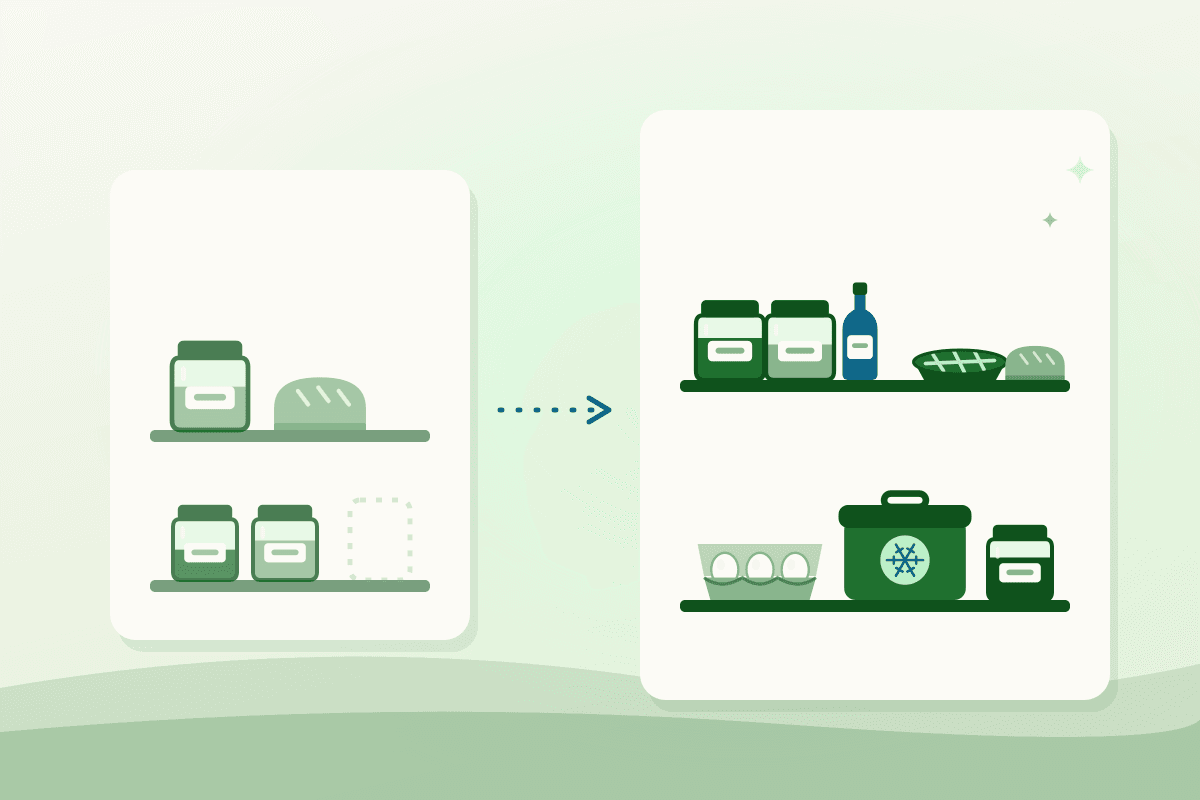
The law then sorts homemade food into two groups:
- Shelf-stable food needs no time or temperature control. The statute’s examples include sealed jams and syrups, fermented foods, granola, honey, popcorn, roasted coffee beans, dried foods, and baked goods without perishable frosting or fillings.
- Perishable food must be held at 41°F or below if cold, or 135°F or above if hot. Examples include coffee and lemonade, sauces and condiments, eggs, nut butters, fresh pasta, raw doughs, cooked vegetables, pickled products, and baked goods with fillings made from animal products.
Perishable food must be made, stored, transported and sold in conditions meant to keep it safe, with instructions on safe storage and preparation (§ 37-205(4)).
Meat, dairy and raw milk
Meat is the biggest exclusion. Section 37-205(2)(c) bars sales of meat with these exceptions:
- Poultry, if you slaughter no more than 1,000 birds of your own raising in a calendar year, don’t buy or sell other producers’ poultry, and the product isn’t adulterated or misbranded
- Live animals, and portions of live animals sold before slaughter for future delivery, including animal shares
- Domestic rabbit meat
- Farm-raised fish raised under Idaho law, except catfish
- Meat from cattle, sheep, pigs and goats inspected by the USDA or another approved inspector
An animal share (§ 37-207) is an ownership interest in an animal or herd, bought under a written contract before slaughter. The meat is delivered within Idaho with a not-for-sale label, and the buyer can’t sell or donate it.
Dairy and raw milk can be sold only in full compliance with Idaho’s existing dairy and raw milk chapters (§ 37-204(3)). The Act covers nonalcoholic drinks only.
Where and how can you sell homemade food in Idaho?
The Act doesn’t list approved venues. Instead, § 37-205(2) sets two conditions on every sale:
- It is between you or your designated agent and an informed end consumer: the final buyer, who doesn’t resell or redistribute the product.
- Everything happens in Idaho. Production, processing, packaging, sale and delivery must all take place in the state, and no sale may involve interstate commerce.
The Idaho Farm Bureau’s explainer lists sales from a farm, ranch, home, farm stand, cooperative market or designated agent. Because the law regulates the transaction rather than the channel, a farmers’ market table, an online order or an in-state delivery can also fit, as long as the buyer is the final consumer and nothing crosses the state line. Markets can still set their own vendor rules.
Designated agents and store shelves
A designated agent is a person, cooperative market, consignment market or other business you name in writing to sell, store or deliver your products. The agent never takes ownership of them (§ 37-203(3)). A retail space that offers these products must keep them physically separate from other stock, including in coolers and storage, and mark the area with signs (§ 37-205(5)).
What the Act doesn’t cover
- Restaurant-style service, food trucks and concessions. Food prepared or served for immediate consumption isn’t homemade under the Act.
- Catering. Caterers are still food establishments under Idaho Code § 39-1602 and stay under the regular food establishment rules.
- Ingredients for licensed kitchens. A food establishment, including a public school kitchen, can’t use these products as ingredients (§ 37-204(3)(d)).
- Wholesale. IDHW says wholesale operations aren’t exempt under the Act.
- Out-of-state sales. Selling or shipping across state lines falls outside the Act, and IDHW notes that selling outside Idaho may require FDA approval.
Those limits are also where many food businesses move into a licensed commercial kitchen. Our commercial kitchen rental guide explains how hourly and monthly rentals work.
Do you need a license or permit to sell homemade food in Idaho?
No. A producer selling under the Act needs no license, permit or inspection. The Act also removed these producers from the definition of a food establishment (§ 39-1602(2)(h)), and a product isn’t treated as adulterated or misbranded under Idaho’s food law just because it was made under the Act.
Under § 37-204, state agencies and local governments, including health districts, can’t adopt or enforce licensing, permitting, inspection, packaging or labeling rules for these products that are stricter than the matching state or federal requirement. Any such rule is unenforceable.
Some rules still apply. Weights and measures, marketing and pesticide laws still cover these products. IDHW can still investigate a confirmed foodborne illness, and producers remain liable for gross negligence or misrepresentation. IDHW must also publish food safety education, and producers are required to become familiar with it (§ 37-206).
What must go on the label?
Disclosure is the core duty. You or your designated agent must tell the buyer the product isn’t subject to inspection or licensing, using a conspicuous sign, a label on the product or a card handed to the buyer. Under Idaho Code § 37-205(3)(b)(i), it must state:
"This product is not subject to government food safety inspection or licensing requirements. It may contain allergens."
The same sign, label or card must also include:
- Your name and contact information
- A list of ingredients, if the product has two or more
Perishable products also need handling instructions that tell the buyer how to store and prepare them safely (§ 37-205(4)(b)), and animal-share meat needs its not-for-sale label. IDHW’s food safety page repeats the statement word for word, so you can copy it from there or from the statute.
What records do you need to keep?
Section 37-208 requires a record of each transaction showing:
- The type and quantity of product sold
- The date of sale and the date of production
- Where the food was produced
- Where each ingredient was produced or acquired
- The designated agent, for any sale an agent handled
Animal-share sellers keep the written contract or bill of sale as their record. Keep records for at least two years. They are confidential: exempt from Idaho’s public records law, and not handed to any state agency, local government or health district unless there is a confirmed foodborne illness investigation. There is no routine reporting.
Records cut both ways. If an illness investigation finds you didn’t keep them, you can be fined up to $500. If you keep and provide them in good faith, the Act says you can’t be held civilly liable for what a buyer or third party later does with the product, such as reselling or misusing it.
How does Idaho compare with California’s MEHKO and Alberta?
Idaho, California and Alberta answer the same question in different ways: what can a home cook sell without a full commercial license? The table compares them on the points that matter most to a small producer.
| Compare | Idaho (SB 1283) | California MEHKO | Alberta low-risk home food |
|---|---|---|---|
| What you can sell | Shelf-stable and perishable homemade food and nonalcoholic drinks; most meat excluded | Meals, including perishable food, prepared and served the same day | Low-risk foods that don’t need refrigeration, such as baked goods, candies, whole fresh produce and some canned goods |
| Where you cook | A home kitchen, farm or other non-licensed facility | Your own home kitchen, after a home evaluation | A home kitchen |
| Permit and inspection | None; officials see records only in a confirmed foodborne illness investigation | County or city permit after an initial inspection, then at most one routine inspection a year | Set by Alberta’s Food Regulation; the province encourages food safety training and points sellers to local business rules |
| Caps | No meal or sales cap | 30 meals a day, 90 a week, $110,442 in gross sales for 2026 | None stated by the province |
| How you sell | Direct to the final consumer or through a designated agent, inside Idaho only | Direct to consumers only; no wholesale or catering | From home (including online and mail order), at special events and at farmers’ markets |
| Accountability | Statutory disclosure label plus two years of sales records | Permit, inspections and a certified food safety exam for the operator | Labels that identify the food and the producer so buyers can ask questions or report a concern |
| Where it applies | Statewide; local rules can’t be stricter | Only where a county or city has opted in | Province-wide |
Idaho trades permits and inspection for disclosure and records, and it covers far more food than most cottage food rules. California’s MEHKO permit allows full meals but keeps a permit, inspections and caps. Alberta stays with low-risk food that doesn’t need refrigeration and sends sellers to their municipality for local business rules.
What are the concerns?
The Act passed by wide margins, but health officials have raised practical questions, and some guidance is still being written.
Product scope and federal law. In a March 2026 update written while the bill awaited the governor’s signature, the South Central Public Health District noted that newly eligible foods include canned vegetables, tamales, barbecue sauces and pickled products. It said many questions remained about what can be sold and “how these new rules interact with federal standards,” and that it would publish guidance after receiving IDHW’s.
Illness tracing. With no routine inspection, the Act relies on disclosure and records. Officials see a producer’s records only after a foodborne illness is confirmed, so tracing a problem depends on producers keeping them well.
Uneven guidance. IDHW’s page, updated July 23, 2026, restates the label and adds that wholesale isn’t exempt and that out-of-state sales may need FDA approval. University of Idaho Extension lists guidance on what can be sold and on labeling as planned work. Some district web pages still describe the old cottage food process, so ask your district which rules it applies.
Liability. The Act doesn’t shield gross negligence or misrepresentation, and the South Central district advised business owners to review their insurance.
The statute’s stated purpose is to make direct sales from Idaho producers easier with minimal regulatory burden. How that balances with food safety will show in how well producers keep labels and records.
Frequently asked questions about Idaho cottage food laws
- Can I sell homemade food in Idaho without a permit?
- Yes. Since March 20, 2026, the Direct-to-Consumer Commerce Act lets you sell homemade shelf-stable and perishable food with no license, permit or inspection. Sell directly to the final consumer, or through a designated agent, inside Idaho, give the required disclosure, and keep sales records for two years.
- Can I sell meals or cater from my home kitchen in Idaho?
- No. The Act excludes food prepared or served on site for immediate consumption, such as restaurant-style service and food trucks. Caterers are still food establishments under Idaho Code § 39-1602, so catering needs a licensed kitchen.
- Can I sell homemade food online in Idaho?
- Yes, if the sale stays in Idaho. The Act doesn’t list sales channels; it requires that the final consumer buys the product and that production, sale and delivery all happen in the state. Include the required disclosure and keep the usual records.
- Can I ship homemade food out of state from Idaho?
- No. Idaho Code § 37-205(2)(b) requires every transaction to take place entirely within Idaho and not involve interstate commerce. IDHW adds that selling outside Idaho may require FDA approval.
- What is a designated agent under Idaho’s food freedom law?
- A person, cooperative market, consignment market or other business you name in writing to sell, store or deliver your products. The agent never owns them, and stores must shelve them apart from other stock under clear signs.
Sources
- Senate Bill 1283 (2026): bill history — Idaho Legislature, Mar 20, 2026
- Senate Bill 1283: bill text — Idaho Legislature
- Idaho Code Title 37, Chapter 2: Idaho Direct-to-Consumer Commerce Act — Idaho Legislature, Mar 20, 2026
- Food Safety: Idaho Direct-to-Consumer Commerce Act — Idaho Department of Health and Welfare, Jul 23, 2026
- The Idaho Direct to Consumer Commerce Act — Idaho Farm Bureau Federation, Jul 30, 2026
- Idaho State Legislative Update — South Central Public Health District, Mar 18, 2026
- Do you want to operate out of your home? — Eastern Idaho Public Health, Sep 8, 2025
- Updated Idaho Food Code takes effect July 1, 2016 — Eastern Idaho Public Health, Jul 1, 2016
- Bulletin 1009: cottage foods in Idaho — University of Idaho Extension, Nov 1, 2021
- Producer food safety for the entrepreneur — University of Idaho Extension
- Low-risk home-prepared foods — Government of Alberta
- MEHKO Adjusted Gross Annual Sales Limit 2026 — California Department of Public Health, Jan 1, 2026
Need to cater, sell wholesale or cook meat? Those still need a licensed kitchen. Rent one by the hour, browse licensed kitchens on Food Web, or create a free account to save kitchens and message hosts.

Written by
Justin Andrews
Kitchen access and local food infrastructure, Atlantic Canada
Justin Andrews is a chef-turned-founder who has spent the last decade working across farms, markets, restaurants, nonprofits, and academic research. He’s now the CEO of Food Web, a platform built to unlock underused commercial kitchens and strengthen local food systems. Justin writes about food, entrepreneurship, and the work of building resilient local economies.